

Over 70 5-Star Reviews
Picking the right dumpster size can feel like a guessing game, but it really just boils down to the scope of your project. If you’re tackling a small job, like a single bathroom remodel or clearing out the garage, a 10 or 15-yard dumpster usually does the trick. For bigger undertakings, like a full kitchen gut or a massive yard cleanup, you’ll want to look at a 20 or 30-yard dumpster.
Figuring out which size you need is easily the most critical part of renting a dumpster. Get it wrong, and you’ll run into problems. A dumpster that’s too small means you’re stuck paying for a second one to finish the job, which is a frustrating and costly delay. But if you go too big, you’ve just paid for a bunch of empty space you didn’t need.
The best approach is to visualize the amount of junk you’ll be tossing. Think of it like renting a moving truck—you wouldn’t get a giant semi to move a small studio apartment. The same logic applies here. A minor renovation creates a fairly predictable pile of debris, making a compact 10-yard dumpster the perfect fit. On the flip side, a major construction or demolition project is going to need the heavy-lifting capacity of a 40-yarder.
Sometimes the term “cubic yards” just doesn’t click. A much easier way to picture it is to think in terms of pickup truck loads. For example, a 10-yard dumpster can hold about three to four full beds’ worth of debris from a standard pickup. This simple comparison makes it much easier to eyeball your junk pile and make a confident choice.
This quick guide gives you a solid visual for how different projects line up with the standard dumpster sizes out there.
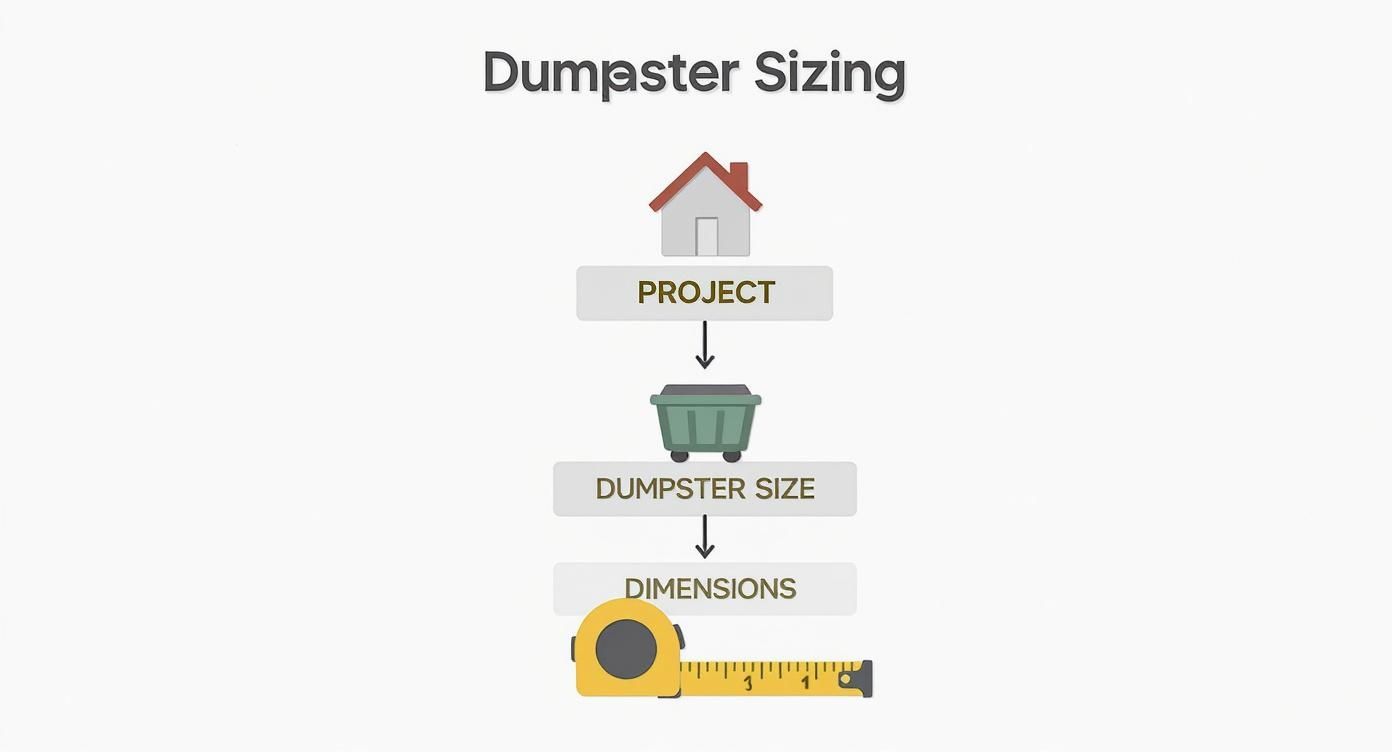
As you can see, the size of your project directly correlates to both the volume and the physical footprint of the dumpster you’ll need on your property.
To make your decision even simpler, here’s a quick comparison table. It breaks down the common sizes, what they can hold in familiar terms, the kinds of jobs they’re perfect for, and their approximate dimensions.
| Dumpster Size (Cubic Yards) | Capacity (Pickup Truck Loads) | Best For These Projects | Typical Dimensions (L x W x H) |
|---|---|---|---|
| 10 Yard | ~4 loads | Small bathroom remodels, single-room cleanouts, dirt/concrete removal | 12′ x 8′ x 3.5′ |
| 15 Yard | ~6 loads | Large bathroom remodels, flooring removal (up to 1,500 sq ft), small deck demolition | 16′ x 8′ x 4.5′ |
| 20 Yard | ~8 loads | Kitchen renovations, full garage/basement cleanouts, roofing jobs (shingles) | 22′ x 8′ x 4.5′ |
| 30 Yard | ~12 loads | Major home additions, new construction, whole-home cleanouts, siding replacement | 22′ x 8′ x 6′ |
| 40 Yard | ~16 loads | Large-scale demolition, commercial construction, major building cleanouts | 22′ x 8′ x 8′ |
This table should give you a great starting point for matching your specific needs to the right container without any guesswork.
While every project has its own unique demands, we see clear patterns in what people rent. The 20-yard dumpster is far and away the most popular choice for both homeowners and contractors. It really hits that sweet spot, offering plenty of capacity without taking up a massive amount of space.
Of course, for the biggest jobs—like commercial demolition or new construction—the 40-yard dumpster is the undisputed heavy-hitter.
Pro Tip: If you’re on the fence between two sizes, it’s almost always smarter and more cost-effective to size up. The price jump from a 10 to a 20-yard container is a lot less than the cost of ordering a second 10-yarder when the first one overflows.
While a comparison chart is a good starting point, the real question is what each container is actually designed to handle on the ground. To figure out what size dumpster you really need, you have to move past the numbers and think about your specific project. Let’s take a practical tour of the four most common roll-off sizes to see where each one truly shines.
You’ll often hear dumpsters grouped into small (10-15 cubic yards), medium (20-25 cubic yards), and large (30-40 cubic yards) categories. Medium sizes are almost always the most popular because they’re so versatile, but the smaller ones are perfect for quick cleanups, while the giants are reserved for major construction or demolition.
Think of the 10-yard dumpster as the go-to for small-scale jobs. It’s compact, fits easily in just about any driveway, and is ideal when you’ve got a concentrated pile of heavy debris. The low walls are a back-saver, too, making it much easier to load dense materials like dirt or broken concrete.
Of course, its small size is also its main drawback. A 10-yarder just won’t cut it for projects with bulky items like old couches, and it fills up way too fast for a cleanout that spans more than a couple of small rooms.
Perfect For These Jobs:
There’s a reason the 20-yard dumpster is the most commonly rented size—it hits that sweet spot between capacity and footprint. It’s big enough to swallow debris from most significant home projects but still fits comfortably in a standard driveway. This makes it the go-to for both homeowners and contractors.
It can handle just about anything you throw at it, from old furniture and appliances during a basement cleanout to drywall and lumber from a kitchen gut. Honestly, if you’re on the fence about which size to get, this is often the safest and most efficient bet. You can learn more about this popular choice in our guide to 20-yard dumpster rentals.
Key Insight: The 20-yard dumpster is what we in the business call the “all-rounder.” It provides plenty of space for common projects without the intimidating size and higher cost of the larger bins.
When you step up to a 30-yard dumpster, you’re planning a serious project. This container is built for jobs that generate a massive amount of waste, like a full home gut, a large addition, or a complete siding replacement. Its higher walls are great for containing bulky construction materials and big, awkward pieces of furniture.
The main thing to keep in mind here is space. A 30-yard dumpster is a big piece of equipment and needs a good amount of clear, flat ground for delivery. It’s an excellent choice for new construction sites or properties with long, wide driveways that can easily accommodate it.
Where It Excels:
The 40-yard dumpster is the biggest one you can get and is typically reserved for the largest jobs out there. We’re talking large-scale commercial construction, major building demolitions, or huge community cleanups after a storm. Its massive capacity is designed to handle an enormous volume of debris, which is why you see them on almost every big commercial job site.
For a residential project, a 40-yarder is almost always overkill unless you’re tearing down the entire house. Its sheer size and weight require specialized placement and can be too much for a typical residential driveway to handle without risking cracks or damage.
Best Suited For:
Figuring out what size dumpster you need isn’t just about the empty space inside. You have to think about your junk in two ways: how much room it takes up (volume) and how heavy it is (weight). This is the part where a lot of people get tripped up.
A dumpster that’s only half-full of broken concrete can easily weigh more than one overflowing with old furniture and drywall. Overlooking the weight is probably the single biggest reason people get hit with surprise overage fees.
Every dumpster you rent comes with a built-in weight limit. This is the total tonnage included in your flat-rate price. If you go over that limit, you’ll have to pay for the extra tonnage when it gets weighed at the landfill—often $50 to $100 per ton. A good estimate upfront can save you a real headache and a lot of money.
Before we get to weight, let’s get a handle on volume. You don’t need to be a math whiz for this. The easiest way is to gather all your junk into a single pile.
Once it’s all together, grab a tape measure and get the length, width, and height of the pile in feet. Then, just multiply those three numbers. That gives you the total cubic feet. Since dumpsters are measured in cubic yards, you’ll do one last step: divide your total by 27.
Here’s a quick example:
Bingo. In this case, a 10-yard dumpster is exactly what you need. It’s a surprisingly accurate method for most projects.
Now for the part that really counts: weight. You could have two identical piles of debris, but one could be ten times heavier than the other. Think about it—a pile of old carpeting and 2x4s is light and fluffy compared to a much smaller stack of roofing shingles or busted-up patio pavers.
This is why you absolutely have to consider what you’re throwing away. For a roofing job or a concrete demolition, the weight adds up way faster than the volume. Always tell your rental company what materials you’re tossing. They’ll make sure the dumpster’s weight allowance can handle your specific type of debris.
Crucial Insight: Heavy debris like concrete, asphalt, dirt, or brick often requires a smaller dumpster (usually a 10-yard). This isn’t because you don’t have enough stuff to fill a bigger one—it’s to keep the truck that hauls it away under the Department of Transportation’s legal road weight limits.
To give you a better feel for this, check out the average weight of common materials. It can be a real eye-opener.
This table gives you a ballpark idea of how much different materials weigh. It’s a great reference to help you guess your total tonnage and avoid going over your limit.
| Material Type | Estimated Weight (lbs per cubic yard) |
|---|---|
| Household Junk (mixed) | ~200 – 350 lbs |
| Drywall (Gypsum Board) | ~500 – 800 lbs |
| Wood (Lumber, Plywood) | ~1,000 – 1,200 lbs |
| Yard Waste (Branches, Soil) | ~1,000 – 1,500 lbs |
| Roofing Shingles | ~2,500 – 3,000 lbs |
| Concrete (Broken) | ~4,000 lbs |
| Brick (Whole or Broken) | ~4,500 lbs |
As you can see, a single cubic yard of broken brick can weigh a staggering 4,500 pounds—that’s more than two tons! This is exactly why getting a handle on both the volume and the type of your debris is the key to choosing the right dumpster and keeping your project on budget.
Knowing what size dumpster you need is half the battle. The other half is knowing what you can—and more importantly, what you can’t—put inside it. Not all debris is created equal, and for very good reasons (safety, environmental, and legal), some materials have special rules.
Getting this wrong can be a real headache. We’re talking rejected loads at the landfill, surprise fees on your final bill, and project-stopping delays. Let’s break down the two big categories you need to get right: super-heavy debris and prohibited hazardous materials.
If your project involves tearing out a driveway, digging up a yard, or demolishing a brick wall, your main concern shifts from volume to weight. Materials like concrete, asphalt, dirt, and brick are incredibly dense. To put it in perspective, just one cubic yard of concrete can tip the scales at over 4,000 pounds.
This is why you almost never mix these materials with regular trash or construction debris. For heavy stuff, you’ll need a dedicated, smaller dumpster—usually a 10-yard or, in some cases, a 20-yard bin. It’s not about running out of space; it’s all about staying road-legal.
The DOT Weight Limit Rule: Every truck on the road, including the one hauling your dumpster, has to follow strict weight limits set by the Department of Transportation (DOT). A big 40-yarder filled with concrete would be dangerously overweight, making it illegal to even pull away from the curb.
Using a smaller, dedicated dumpster for heavy materials ensures the total load is safe and compliant. This keeps the driver safe, avoids hefty fines, and keeps your project moving smoothly.
Now for the stuff that should never go into a standard roll-off dumpster, no matter the size. These items are banned because they’re genuine hazards. They can leak toxic chemicals into the soil and groundwater, release harmful fumes, or even start fires at the landfill or recycling facility.
The construction and demolition industry is a massive waste generator. In the U.S. alone, it churns out around 600 million tons of debris every single year. Managing this responsibly is a huge challenge, and it starts with keeping hazardous materials out of the general waste stream. You can dig deeper into industry trends with data from sources like Verified Market Reports.
Here’s a quick-reference list of common no-gos:
Before you start tossing, do a quick check with your local city or county waste authority. They’ll have guidelines on where to take these items, often to a specific recycling center or a designated hazardous waste collection event. A little planning here goes a long way in keeping your project, and your community, safe.
You’ve zeroed in on the right dumpster size—that’s a huge part of the puzzle. But the job isn’t done yet. Now it’s time to tackle the practical side of things to make sure your rental goes off without a hitch, from the moment it arrives to the final pickup. We’re talking about permits, pricing, and what’s actually included in your rental, so you don’t get any nasty surprises on the final bill.
First thing’s first: where is this dumpster going to live? If you have a spot on your own property, like a driveway, you’re probably in the clear. But if you need to place it on a public street, sidewalk, or alley, you’re almost certainly going to need a permit from your local government.
Trust me, trying to sneak a giant steel box onto public land without permission is a bad idea. It can lead to fines and a demand for its immediate removal, which can throw your whole project into chaos. It’s a simple step, but a critical one.
Figuring out the permit situation is usually pretty straightforward. The best place to start is your city or township’s website. Search for the public works, building department, or streets department page, as they’re the ones who typically issue what are called “right-of-way” or “encroachment” permits.
If you strike out online, just call your local city hall. They can quickly tell you:
Important Takeaway: Never just assume you don’t need a permit. These rules are in place for public safety and access, and they are strictly enforced. If you’re using public space, getting that permit is non-negotiable.
Once you know where the dumpster is going, the next question is always about the cost. Most rental companies, including us here at Dumpsters Now, operate on a flat-rate pricing model. This is a huge benefit for your budget because it bundles all the main costs into a single, predictable price.
So, what does that flat rate usually cover?
The key detail to focus on here is the weight allowance. Your flat rate includes a specific tonnage. If you go over that limit, you’ll face an overage fee for every extra ton. For a precise quote tailored to your project, you can easily request dumpster rental pricing online.
While flat-rate pricing is designed to be transparent, a few things can trigger extra charges. Knowing what they are ahead of time is the easiest way to avoid them and keep your project on budget.
Nailing down these logistics is more important than ever. The global dumpster market was recently valued at around USD 1.18 billion and is expected to grow as more people tackle big projects. By getting your permits in order and understanding the costs, you’re setting yourself up for a smooth, efficient process without any budget-busting mistakes.
https://www.youtube.com/embed/2G654KYaNB8
Once that dumpster is sitting in your driveway, the real work begins. Getting the most out of your rental isn’t just about what you throw in, but how you throw it in. A little bit of strategy goes a long way.
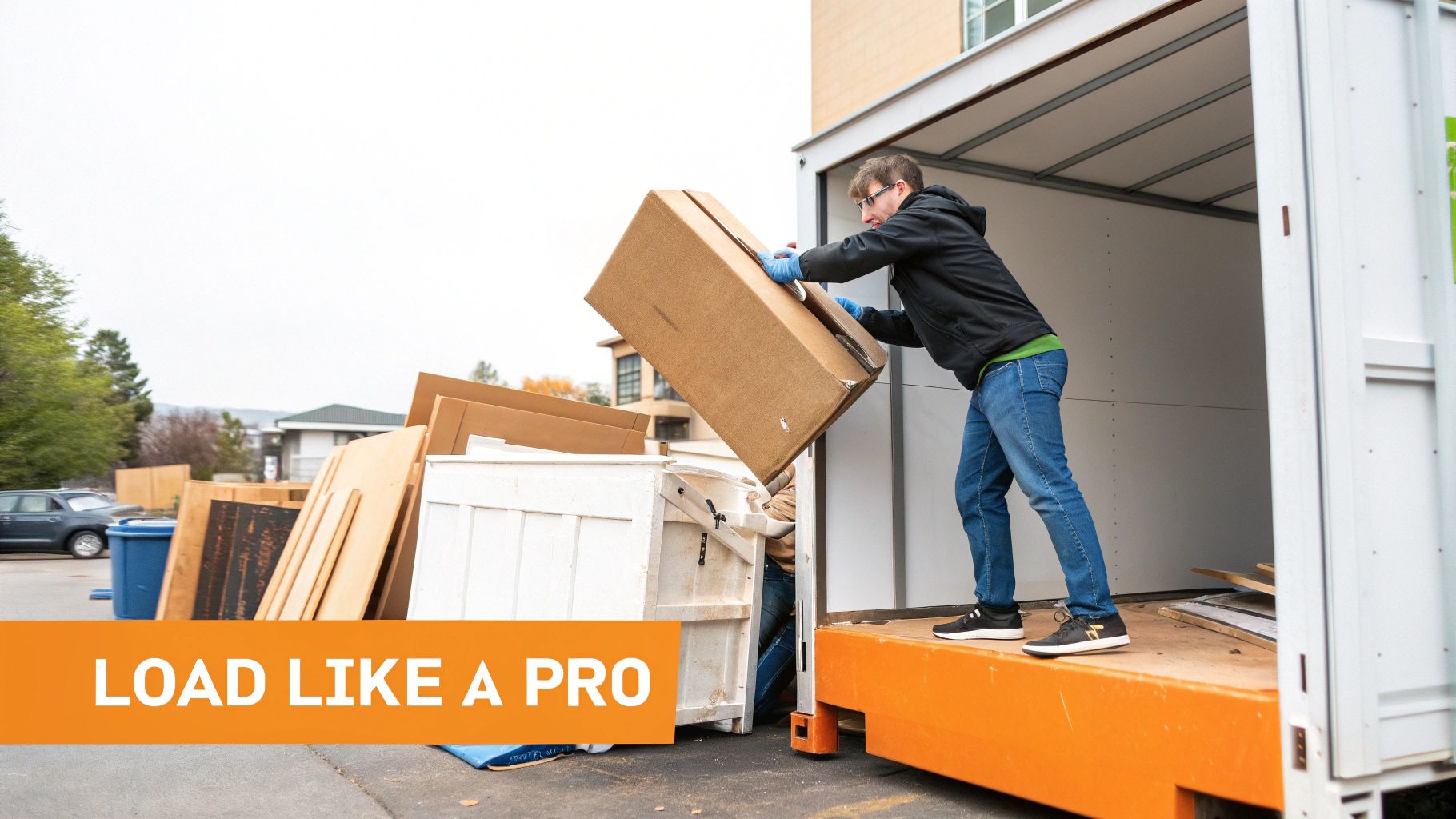
Think of it like a game of Tetris. The goal is to fit everything together perfectly, leaving as little empty space as possible. A well-packed dumpster can be the difference between a one-and-done project and the headache of ordering a second container. Start smart: don’t try to lift heavy stuff over the sides. Just open the hinged door at the back and walk your biggest items right in.
The golden rule of loading is to put your heaviest and bulkiest items in first. Spread them out across the floor to create a solid, stable base. This isn’t just for saving space—it keeps the dumpster from becoming dangerously top-heavy and unbalanced when we come to haul it away.
After that, your mission is to break everything down. This is probably the single most important tip for maximizing your rental’s value.
Safety First: The Fill Line Rule
You absolutely must keep all debris level with or below the top rim of the dumpster. Overfilling is a major safety hazard. Items can fly out on the road, creating a serious risk for other drivers. Our drivers are legally forbidden from hauling overloaded containers, which means you could be stuck with a “trip fee” and a delayed project while you unload the excess.
Loading a dumpster is a process, not a sprint. Follow these simple steps, and you’ll avoid creating those frustrating air pockets that waste valuable space.
This layering technique does more than just save space—it ensures the entire load is balanced for a safe and smooth pickup.
Even after breaking down all the sizes, a few common questions always pop up right before someone is ready to book. I get it—you want to be absolutely sure you’re making the right call. So, let’s run through the most frequent things people ask our team every day.
Think of this as a final gut-check. Getting these last few details straight will help you rent with confidence and avoid any surprises down the road.
This is probably the number one concern, and for good reason. Going over the weight limit included in your rental almost always leads to overage fees. These are extra charges, usually billed per ton, for any weight beyond what you paid for upfront.
The best way to sidestep this? Be totally upfront about what you’re throwing away. A good, honest estimate of your debris—especially if you’re dealing with heavy stuff like concrete or roofing shingles—lets the rental company set you up with the right dumpster and a proper weight allowance from the start. That little bit of transparency can save you a real headache and a big bill later.
Yes. One hundred percent, yes. If you’re on the fence between two sizes, always go with the larger one. This is one of the most important pieces of advice I can give.
The price difference between a 20-yard and a 30-yard dumpster is a whole lot smaller than what it costs to rent a second dumpster because you ran out of space. Sizing up gives you a crucial safety net and is almost always the smarter financial decision.
For most common projects, absolutely. You can toss general household junk, old furniture, and light construction debris like drywall and wood all into the same container.
But there’s a big exception: super heavy materials. Things like concrete, asphalt, dirt, and brick usually need their own dedicated dumpster. This isn’t just a company preference; it’s a safety issue tied to federal road weight limits and rules at local landfills or recycling centers. Always double-check with your rental provider about what you can and can’t mix.
Your typical rental period is usually somewhere between 7 and 14 days, which is plenty of time for most projects. The good news is, there’s usually a lot of flexibility.
If your project hits a snag and you need more time, nearly every company will let you extend your rental for a flat daily rate. On the flip side, if you get everything done early, just give them a call for a pickup. The key is to confirm the standard rental window and any extension fees before you finalize your order.
Still have questions, or are you ready to get the right size dumpster heading your way? The team at Dumpsters Now provides same-day or next-day delivery across Metro Detroit to keep your job on schedule. Get a fast, free quote by visiting us online at https://dumpstersnow.com.
Yes. All of our dumpster rentals will have a hinged back door that will easily swing open.
No. Roll-off dumpster rentals do not include any type of cover or lid. We recommend using a tarp to cover the dumpster to prevent nearby residents from throwing unwanted trash in your dumpster.
The truck that carries the roll off dumpster drives onto a scale at the disposal facility where an initial weight is recorded. Next, the truck empties the contents and drives onto the scale again to record the weight of the truck and the empty dumpster. The difference between the first and second weight is the weight of the debris in the dumpster. All of our scales are regulated by the state bureau of weights and measures.
Large and bulky electronic waste items, mattresses, tires, and items containing freon may incur a per-item fee at the disposal facility. Every situation is different, so please contact us for more details.
Hazardous waste is prohibited. This includes chemical products, herbicides, pesticides, radioactive material, solvents, flammable liquids, propane tanks, motor oil, transmission oil, contaminated oils mixed with solvents, gasoline, antifreeze, petroleum contaminated soil, lead paint chips, microwaves, fluorescent tubes, medical waste, asbestos, and animals.
Contact us and let us know what you plan on using the dumpster for. We’ll let you know if any of your items are prohibited.
The price of our dumpster rentals include a one-time delivery and removal for the selected roll off dumpster, a disposal weight allowance, and the agreed upon rental period.
This depends on the size of the dumpster you rent. With that being said, the Department of Transportation regulations limit the weight of any roll off dumpster to approximately 15 tons.
Please review the applicable additional weight charges per the terms and conditions of your agreement. Contact us for more information.
Yes. If the weight of the materials in your dumpster exceeds the included weight quoted in your order confirmation, you will be charged for the additional weight. We are charged by weight at the disposal facility and we pass along this charge accordingly.
Don’t let clutter or delays hold you back. With Dumpsters Now, you get fast, reliable dumpster rentals delivered when you need them.
Call or book online today!
What Is a Roll Off Dumpster Your Complete Guide says:
[…] If you want an even more detailed look at what might work for you, our team created a helpful guide on how to determine what size dumpster you need. […]
How to Plan Home Renovation: A Smart Guide says:
[…] tossing. To budget correctly, you have to estimate how much waste you'll create. Our guide on what size dumpster you might need is a great resource to help you get a realistic quote for your budget. Nailing this down early […]
Kitchen Renovation Steps: A Clear ClickWorthy Remodel Guide says:
[…] Properly planning your debris removal ensures the worksite stays clean and safe. Before ordering, it’s wise to estimate the volume of waste you’ll produce. For more information to help you select the right container for your project, you can get specific guidance on what size dumpster you might need. […]