

Over 70 5-Star Reviews
So, fall is here. The colors are incredible, but that also means your yard is about to be buried in leaves. If you're in Southeast Michigan, you know exactly what I'm talking about. For homeowners across Wayne, Oakland, and Macomb counties, figuring out the best way to handle the leaf invasion is an annual puzzle.
This isn't just about raking; it's about choosing the right game plan. Your decision really boils down to three things:
Choosing your strategy doesn't have to be complicated. The best method really just depends on how many leaves you're dealing with. Think of it like a simple decision tree.
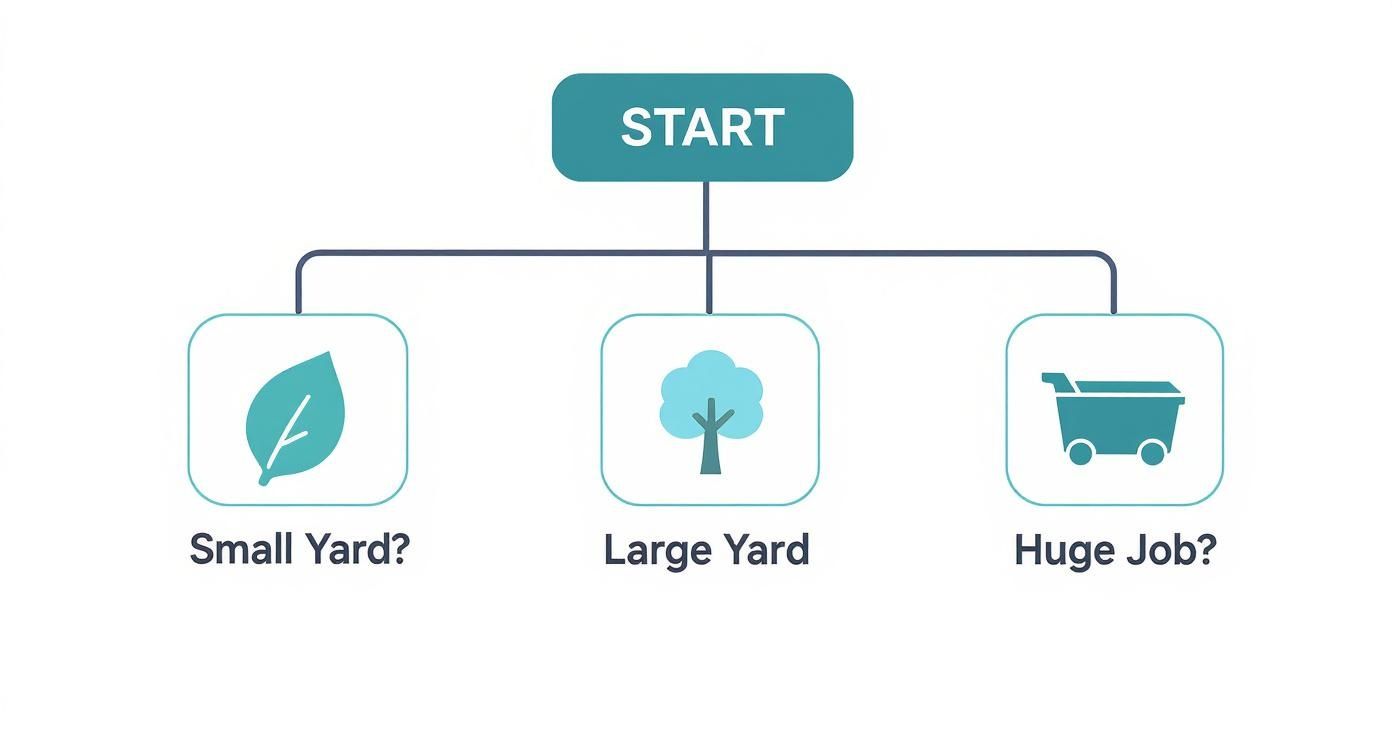
As you can see, the more leaves you have, the more you need a heavy-duty solution. A few bags for a small yard is one thing, but when you're facing a mountain of them, a roll-off dumpster becomes the most practical plan.
Let's break down the most common options to help you decide.
To make it even clearer, here's a quick rundown of the main leaf disposal strategies. This table should help you zero in on what makes the most sense for your situation this fall in Macomb, Oakland, or Wayne county.
| Method | Best For | Cost | Effort Level |
|---|---|---|---|
| Mulching/Composting | Small yards with a few trees; garden enthusiasts | Low (free if you own a mower/composter) | Moderate |
| Curbside Pickup | Average suburban yards with a manageable volume | Low (often included in taxes, but bags cost money) | High |
| Municipal Drop-Off | Homeowners with a truck who can haul their own leaves | Low to Moderate (may have fees per load) | High |
| Roll-Off Dumpster | Large properties, heavy tree cover, big cleanups | Moderate to High | Low |
Each of these has its place. Mulching is fantastic for your garden soil, but it's not practical if you have 50 giant trees. Curbside pickup is convenient, but the labor involved in bagging everything can be a real backbreaker.
For properties in Oakland County with dozens of mature trees, a roll-off dumpster often becomes the most efficient tool. It saves homeowners from the repetitive labor of bagging and hauling, letting them knock out the entire job in a single weekend.
If you're staring out at a yard that looks completely overwhelming, a roll-off dumpster might be your best bet. You can check out our local service areas to see what’s available in your neighborhood. The right choice helps you reclaim your fall weekends instead of spending them wrestling with leaf bags.
Before you even think about starting that annual ritual of bagging up endless piles of leaves, let's talk about a different approach. For a lot of homeowners, especially in places like Wayne and Macomb County, those fallen leaves aren't just a chore. They're a resource—a pretty valuable one, at that—that can seriously boost the health of your lawn and garden.
Two of the best and most earth-friendly ways to handle leaves are composting and mulching. These aren't just trendy green practices; they save you time, turn a seasonal headache into a real benefit for your property, and stop you from hauling bags to the curb. By recycling leaves right where they fall, you cut down on waste and create your own nutrient-rich soil amendments for free.
Composting is basically nature's recycling program. It's the process of turning organic stuff into a dark, crumbly soil conditioner that gardeners rightfully call "black gold." Fallen leaves are the perfect "brown" material for your compost pile, giving it the carbon it needs to balance out nitrogen-heavy "green" materials.
Starting a compost pile is way simpler than it sounds. You can grab a dedicated bin or just pick a discreet corner of your yard to get started.
In just a few months, you'll have a pile of rich, earthy compost ready to supercharge your garden beds and potted plants. And it all came from stuff you were about to throw away.
This might be the easiest method of all. Instead of raking and bagging, just mow right over the leaves. Your lawnmower will shred them into tiny pieces that settle down into the turf, disappearing from sight.
This simple trick, often called "mow-in mulching," lets those shredded leaf bits decompose over the winter. As they break down, they feed your lawn's roots by releasing valuable nutrients directly into the soil—think of it as a natural, slow-release fertilizer.
Come spring, your lawn will be noticeably healthier and greener, and you won't need to rely as much on chemical fertilizers. For this to work best, make sure the leaves are relatively dry. You also don't want the leaf layer to be so thick that it completely smothers the grass. A few passes with the mower is usually all it takes.
This approach is incredibly efficient and directly benefits the little ecosystem in your own backyard. It also makes a dent in a huge environmental problem. The Environmental Protection Agency (EPA) estimates that yard debris, including leaves, makes up about 13% of all the solid waste we send to landfills. By composting and mulching, you're officially part of the solution. If you want to see the bigger picture, you can check out more global waste generation data from Statista.
For a lot of homeowners around Metro Detroit, just dragging the bags to the curb is the default way to handle fall leaves. It makes sense—it’s convenient, you’re already used to it, and your local taxes are paying for the service anyway.
But here’s the thing: the rules for yard waste can be surprisingly strict, and they change from one town to the next. One simple mistake, like using the wrong kind of bag, and your hard work will be sitting on the curb until next week’s pickup.
The guidelines in Sterling Heights over in Macomb County can be completely different from what Livonia requires in Wayne County. Getting a handle on these local details is the real secret to a smooth, hassle-free fall cleanup.
Every municipality has its own playbook for curbside leaf collection, and knowing the rules upfront saves a ton of headaches. You should always double-check your specific city or township’s website, but here are some of the most common requirements you’ll find across the region.
It’s absolutely critical to check your local city’s Department of Public Works (DPW) website for the exact schedule and guidelines. A quick search for "City of [Your Town] yard waste pickup" will usually pull up the official rules you need to follow.
So, what happens if your pile of bags is bigger than the weekly limit? Or what if you miss that last collection day of the season? This is where standard curbside service starts to fall short. If you've got a yard in Oakland County with a few big, mature trees, it's incredibly easy to end up with more bags than they'll take in one go.
This usually leads to a couple of not-so-great options: storing soggy, decomposing bags for another week or trying to haul them off somewhere yourself.
Many communities in Oakland, Wayne, and Macomb County offer municipal drop-off sites as an alternative, which can be a decent backup plan. These sites let you bring your extra yard waste directly to a designated facility. Of course, this means you need a truck or a big enough vehicle, plus the time and energy to load, drive, and unload everything on your own.
When you're staring down dozens of bags and a tight collection schedule, the time and effort add up fast. If all that bagging and hauling sounds like a chore you’d rather skip, renting a roll-off dumpster can be a much more efficient way to get the job done.
While curbside service works fine for the average suburban lawn, there’s a tipping point where bagging leaves stops being practical. Suddenly, it’s an overwhelming, multi-weekend project that takes over your life.
For large properties, major seasonal cleanups, or clearing an overgrown lot, the sheer volume of leaves can completely swamp city services—and your patience.
This is where renting a roll-off dumpster becomes the smartest, most efficient solution. It’s not just about getting a big box delivered. It’s about reclaiming your time and finishing a massive job without the stress and endless trips to a drop-off site.
Not every yard needs a dumpster, but for certain situations, it's the undisputed champion. If you're nodding along to any of these, it’s probably time to consider a rental.
A classic example is cleaning up a multi-acre property in Oakland County packed with mature oak and maple trees. That amount of leaves can easily fill 50 to 100 yard waste bags—far beyond what any municipal service will accept in a single pickup.
Another all-too-common situation is dealing with heavy storm debris. After a big storm blows through Wayne or Macomb County, you're not just dealing with leaves. You're left with a messy mix of fallen branches, twigs, and mountains of wet, heavy leaves. A roll-off dumpster lets you toss all this mixed yard waste in together, something you absolutely can't do with standard curbside collection.
A roll-off dumpster transforms a daunting, week-long cleanup into a manageable weekend task. Instead of bagging, hauling, and stacking, you can simply rake or blow everything directly into one container and have it hauled away.
Finally, you just can't beat the convenience. If you want to conquer a massive yard cleanup in one big push and be done with it, a dumpster is your best friend. It eliminates the physical strain of lifting dozens of heavy bags and the logistical nightmare of coordinating multiple disposal trips.
Renting a dumpster for yard waste is pretty straightforward, but picking the right size is the key to an efficient and cost-effective cleanup. You don’t want to pay for a huge container you only half-fill, but you definitely don't want one that's too small, forcing you to overstuff it.
Here's a quick guide to help you choose:
It’s also crucial to understand what you can and can't put in a yard waste dumpster. Generally, you can mix in leaves, small branches, twigs, grass clippings, and other organic plant material. Just be sure to keep out items like soil, rocks, plastic bags, and general household trash, as these contaminants can lead to extra disposal fees.
If you're new to the idea, a roll-off dumpster is just a large, open-top waste container that's delivered to your property and then "rolled off" the back of a specialized truck. Their design is what makes them so perfect for projects like a massive leaf cleanup. If you'd like to dive deeper, our guide on what is a roll-off dumpster provides a detailed explanation of how they function and their various uses.
One of the best features is the hinged back door, which swings open to create a walk-in entrance. This means you don't have to strain your back lifting heavy wheelbarrows or bags over the high sides. You can walk or wheel everything directly inside, which speeds up the entire process significantly.
Once your project is done, the company comes back, picks it up, and hauls it all away. It’s the ultimate set-it-and-forget-it solution for how to dispose of leaves on a large scale.
Getting rid of leaves isn't just about making your yard look good—it’s also about doing it safely and playing by the local rules. No matter which method you pick, a few simple precautions will keep your cleanup safe for you, your family, and your neighbors here in Southeast Michigan.
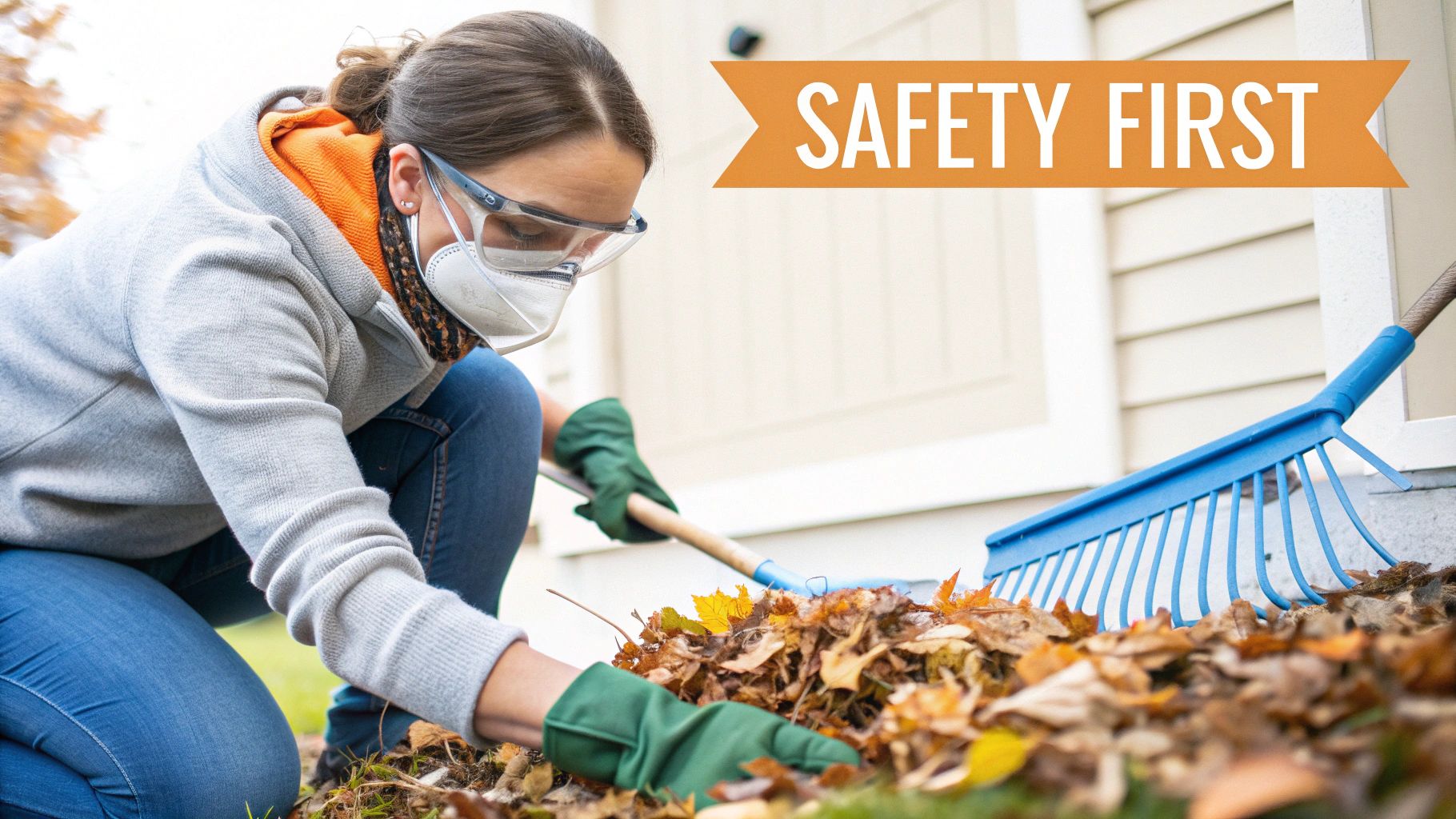
Before you even touch a rake, make sure you've got the right gear. Leaf piles, especially when they're damp, can become a breeding ground for mold and mildew. Breathing that stuff in is a fast track to allergies or worse.
This basic gear can be the difference between a productive afternoon and a week of coughing and itchy skin.
In most of our suburban communities across Oakland, Wayne, and Macomb counties, burning leaves is not only illegal but also incredibly dangerous. These local ordinances aren't just for show; they exist for serious safety and environmental reasons.
Open burning pumps nasty pollutants into the air, which is terrible for anyone with asthma or other respiratory conditions. Even more critical, a single stray ember from a leaf fire can easily set dry grass or a neighbor's shed ablaze, creating a major fire risk for the whole block. Do yourself a favor and just assume burning is off the table.
Whatever you do, never dump your leaves near storm drains, in local creeks, or in public wooded areas. This is illegal dumping. It clogs up drainage systems, which can cause flooding, and it pollutes our waterways with excess nutrients that wreck the local aquatic ecosystems.
If you’re using power tools like a leaf blower, be a good neighbor. Pay attention to the noise and try to work during reasonable hours. And, of course, make sure all your equipment is in solid working order before you start.
For those massive cleanups requiring a roll-off dumpster, the same safety mindset applies. When you're loading it up, try to distribute the weight of the leaves and branches as evenly as you can. If you're mixing in other yard waste and aren't sure what's allowed, take a quick look at our guide on what you can put in a dumpster. A little bit of prep work ensures your project goes off without a hitch—safely, legally, and efficiently.
Even with the best game plan, questions always pop up during a big fall cleanup. I’ve seen homeowners all over Southeast Michigan run into the same hurdles, especially when trying to figure out the smartest way to handle a mountain of leaves.
Let's tackle some of the most common questions we hear from folks in our local communities.
A roll-off dumpster becomes your best friend when you’re staring at a leaf pile that would take more than 20-30 of those big paper yard waste bags to clear. If the thought of all that bagging, dragging, and hauling makes your back ache, it’s probably time to think about a roll-off dumpster.
It’s the right call in a few common scenarios in Macomb, Wayne, and Oakland County:
Bottom line, it saves a ton of time and physical effort. It turns what could be a multi-week chore into a manageable weekend project.
When you rent a roll-off dumpster specifically for yard waste, you can typically load it with all sorts of organic material from your property. This is a huge leg up on curbside services, which often have really strict rules about what they’ll take.
Generally, you’re good to go with:
The key is to keep non-organic stuff out. Avoid tossing in things like plastic bags, rocks, soil, big stumps, or any household trash. Mixing that stuff in can contaminate the whole load and might lead to extra fees from the disposal site.
Always double-check with your dumpster rental company in the Oakland, Wayne, or Macomb area about their specific rules for a "clean" yard waste load. A quick call upfront ensures a smooth rental without any surprise charges on your bill.
Both are fantastic, earth-friendly options, but the right choice really boils down to your goals. One is a quick win for your lawn, while the other is more of a long game that pays off big for your garden.
Mulching is just shredding the leaves with your lawnmower and letting the pieces fall back into the grass. It's a fast, low-effort way to feed your lawn with slow-release nutrients all winter. If a healthier lawn with minimal work is what you're after, mulching is the way to go.
Composting, on the other hand, is a more involved process that turns your leaf pile into rich soil amendment. This "black gold" is incredible for boosting garden beds and potting soil next spring. If you're a serious gardener, the effort you put into composting will be rewarded tenfold.
Honestly, a lot of people find a hybrid approach works best—mulch as much as you can directly on the lawn and start a compost pile with the rest.
When your fall cleanup in Wayne, Oakland, or Macomb county is too big for bags, Dumpsters Now delivers the perfect solution right to your driveway. Get your free quote and schedule your roll-off dumpster rental today at https://dumpstersnow.com.
Yes. All of our dumpster rentals will have a hinged back door that will easily swing open.
No. Roll-off dumpster rentals do not include any type of cover or lid. We recommend using a tarp to cover the dumpster to prevent nearby residents from throwing unwanted trash in your dumpster.
The truck that carries the roll off dumpster drives onto a scale at the disposal facility where an initial weight is recorded. Next, the truck empties the contents and drives onto the scale again to record the weight of the truck and the empty dumpster. The difference between the first and second weight is the weight of the debris in the dumpster. All of our scales are regulated by the state bureau of weights and measures.
Large and bulky electronic waste items, mattresses, tires, and items containing freon may incur a per-item fee at the disposal facility. Every situation is different, so please contact us for more details.
Hazardous waste is prohibited. This includes chemical products, herbicides, pesticides, radioactive material, solvents, flammable liquids, propane tanks, motor oil, transmission oil, contaminated oils mixed with solvents, gasoline, antifreeze, petroleum contaminated soil, lead paint chips, microwaves, fluorescent tubes, medical waste, asbestos, and animals.
Contact us and let us know what you plan on using the dumpster for. We’ll let you know if any of your items are prohibited.
The price of our dumpster rentals include a one-time delivery and removal for the selected roll off dumpster, a disposal weight allowance, and the agreed upon rental period.
This depends on the size of the dumpster you rent. With that being said, the Department of Transportation regulations limit the weight of any roll off dumpster to approximately 15 tons.
Please review the applicable additional weight charges per the terms and conditions of your agreement. Contact us for more information.
Yes. If the weight of the materials in your dumpster exceeds the included weight quoted in your order confirmation, you will be charged for the additional weight. We are charged by weight at the disposal facility and we pass along this charge accordingly.
Don’t let clutter or delays hold you back. With Dumpsters Now, you get fast, reliable dumpster rentals delivered when you need them.
Call or book online today!