

Over 70 5-Star Reviews

It all starts with a single, crucial step: clearly defining your goals and vision. Before you even think about pricing materials or calling contractors, you have to get honest about what you need versus what you want. This is the secret to creating a focused plan that adds real value and stops budget-draining scope creep in its tracks.
A beautiful renovation isn’t just about the final coat of paint or the shiny new countertops. The real magic happens long before that, in the careful, upfront planning. One of the biggest mistakes I see homeowners make is jumping straight into demolition without a clear vision. It’s a fast track to frustration, wasted money, and a finished project that just doesn’t feel right.
Think of it like drawing a map before a road trip. You wouldn’t just start driving without a destination, right? Your renovation needs that same clear endpoint—a vision of how the space will look, feel, and function when it’s all done. This is non-negotiable, whether you’re modernizing a historic home in Detroit or updating a classic suburban house in Macomb County.
Your first and most important task is separating the “needs” from the “wants.” This isn’t about killing your dreams; it’s about smart prioritizing.
Making two separate lists is a game-changer for your budget. When money gets tight (and it often does), you can make sure every single “need” is covered before you even consider spending on the “wants.” It’s a simple trick that can save you from a world of financial stress.
With your priorities straight, now comes the fun part: gathering inspiration. But you have to do it with a practical eye. It’s so easy to get lost in a sea of picture-perfect rooms online that are completely unrealistic for your space or budget.
Stay focused. Look for ideas that directly solve the problems you put on your “needs” list. For instance, if your Oakland County kitchen feels cramped, don’t just pin photos of massive gourmet kitchens. Instead, hunt for clever storage solutions and layouts specifically designed for small spaces.
This simple workflow helps you visualize the path from identifying what’s essential to forming a rock-solid plan.
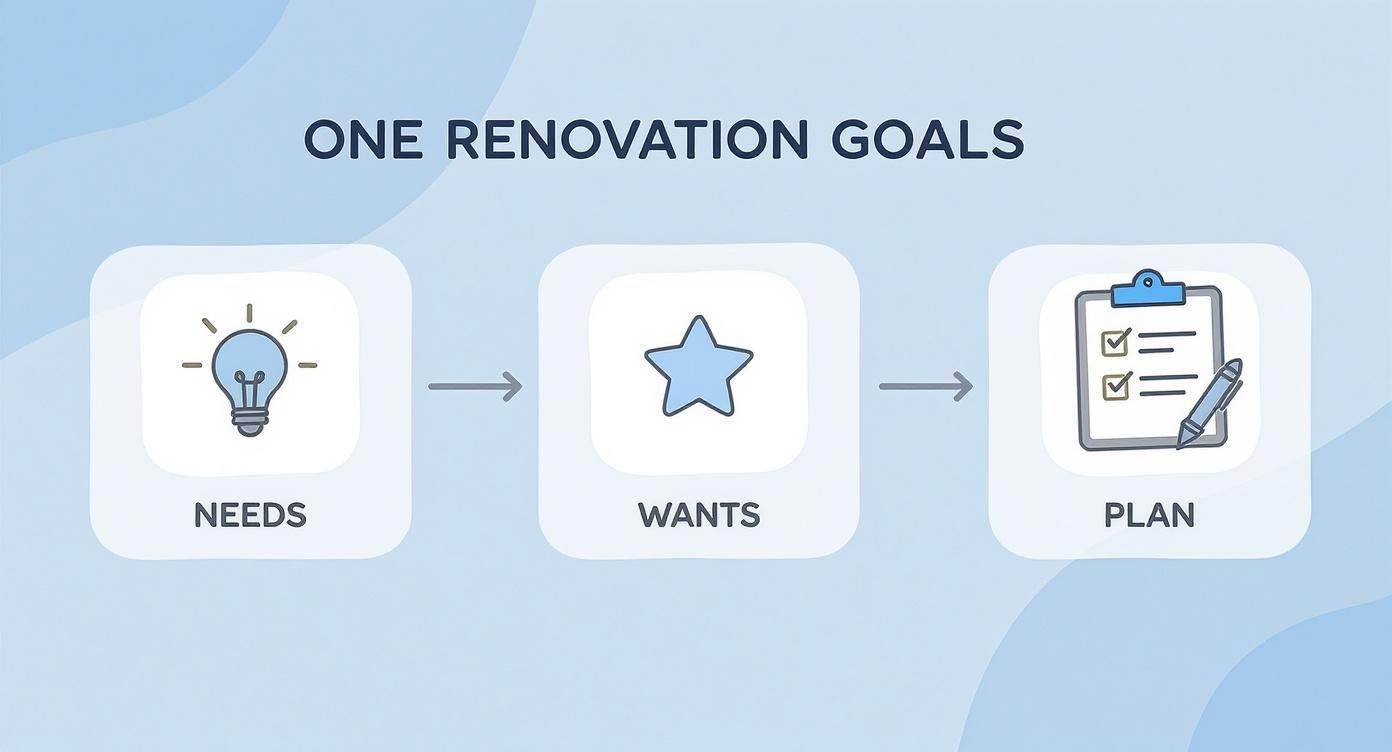
As the visual shows, a real plan only comes together after you’ve taken the time to sort your absolute must-haves from your wish-list items.
It also helps to understand the bigger picture. In 2025, U.S. homeowners are on track to spend a staggering $509 billion on home improvements. Kitchens and bathrooms are still the top projects, making up 38% and 26% of renovations, respectively. Why? Because they offer a great return on investment and make daily life so much better. With the median cost for even a small kitchen remodel hitting $35,000 in 2024, that well-defined vision becomes your best tool for managing rising costs. (Explore more home improvement industry forecasts to see the trends.)
To get your own thoughts organized, use this quick checklist to brainstorm your goals and set a clear direction right from the start.
| Planning Step | Key Question to Answer | Action Item |
|---|---|---|
| Define the ‘Why’ | What is the main problem this renovation solves? | Write a one-sentence “mission statement” for your project. |
| List the Needs | What must be fixed or changed for the home to function better? | Create a bulleted list of non-negotiable items (e.g., fix leaky faucet, add counter space). |
| List the Wants | What upgrades would be great to have if the budget allows? | Make a separate “wish list” of dream items (e.g., heated floors, high-end appliances). |
| Set Functional Goals | How do you want to use this space differently? | Describe the ideal daily activities in the new space (e.g., “host family dinners without being cramped”). |
| Gather Inspiration | What styles and features align with your goals? | Create a digital or physical mood board with images that fit your needs and budget. |
| Define Success | What will make you feel this project was a success? | List 3-5 key outcomes you want to achieve by the end of the renovation. |
Walking through these questions forces you to think critically about what you’re trying to accomplish, which is the bedrock of any renovation that finishes on time, on budget, and exactly as you hoped.

Alright, you’ve got the vision. Now it’s time to bring that dream renovation down to earth with a rock-solid budget and timeline. This is where the practical side kicks in, turning your ideas into a plan that works with real numbers and real dates. A successful project depends on a budget that sees beyond just the big-ticket items like labor and materials.
It’s shockingly easy to underestimate what a project will really cost. The Houzz 2025 Renovation Trends report, for example, shows that median spending on kitchen and bathroom remodels jumped by 9% and 13% respectively in 2024. With the total U.S. remodeling market expected to hit a staggering $509 billion, these aren’t just numbers—they’re a clear sign that careful financial planning is non-negotiable. You can dive deeper into these trends and what they mean for homeowners in this insightful report on 2025 remodeling trends.
One of the biggest mistakes I see homeowners make is forgetting about the “soft costs.” These are all the necessary expenses that aren’t directly tied to swinging a hammer, and they’re the sneaky budget-busters that can trip you up.
Your budget needs to have clear line items for things like:
The most crucial line item in any renovation budget? The contingency fund. You absolutely must set aside 15-20% of your total project cost for the unknown. This is your safety net for when you open up a wall and find hidden water damage, old wiring, or other surprises. Trust me, they happen.
Thinking about how you’ll handle debris right from the start will save you a ton of headaches and money. A simple bathroom remodel in an Oakland County home might just need a 10-yard roll-off dumpster. But if you’re gutting a whole kitchen in Wayne County, you could easily fill a 20-yard roll-off container with old tile, drywall, and cabinetry.
The cost isn’t just about the size of the roll-off dumpster, but also the weight of what you’re tossing. To budget correctly, you have to estimate how much waste you’ll create. Our guide on what size dumpster you might need is a great resource to help you get a realistic quote for your budget. Nailing this down early prevents surprise overage fees and keeps your project humming along smoothly.
Your timeline is every bit as important as your budget. It’s the project roadmap, and it needs to cover way more than just the actual construction phase. A realistic schedule is the key to avoiding the frustration of living in a chaotic construction zone for longer than you have to.
Break your project down and map out every single step:
Always, always build buffer time into your schedule. Delays are just part of the renovation game. A key subcontractor might get sick, a delivery could be late, or an unexpected issue might bring work to a temporary halt. A flexible timeline is a stress-free timeline.

Let’s be blunt: the success of your entire renovation rides on the team you hire. You can have a perfect plan and a crystal-clear vision, but they’re only as good as the hands that bring them to life. Getting the right professionals on board isn’t just another box to check—it’s the foundation of a smooth project and can turn a potential nightmare into a genuine partnership.
Finding dependable contractors, architects, and designers across Wayne, Oakland, and Macomb counties means digging deeper than a quick online search. It’s all about smart vetting and asking the tough questions to build a team that gets your vision and respects your wallet.
Kick off your search with the people you trust. Ask friends, family, or neighbors who’ve recently renovated in areas like Macomb Township or Novi for their recommendations. A word-of-mouth referral is gold because it comes from firsthand experience—the good, the bad, and the ugly.
Beyond your personal network, don’t overlook local building supply stores. The folks at the pro desk often know which contractors are busy, reliable, and do quality work.
Once you’ve got a shortlist of three to five candidates, it’s time to interview them. This is your chance to see if their expertise, communication style, and personality are a good fit.
When you start talking numbers, you need to know the difference between an estimate and a quote. An estimate is just a ballpark figure, a rough guess given early on. It’s not a number you can take to the bank.
A quote, however, is a detailed, fixed-price offer for a clearly defined scope of work. Always, always insist on a detailed written quote from your top choices. It needs to break down the costs for labor, materials, permits, and everything in between so there are no nasty surprises later.
A vague quote is a massive red flag. A true professional will give you a detailed breakdown of every single cost, from demolition labor down to the roll-off dumpster rental for debris. If they’re hand-wavy about specifics, it might signal disorganization or an attempt to pad the bill later.
For example, a solid quote for a kitchen gut in a Troy home won’t just say “debris removal.” It will specify the cost of a 20-yard roll-off dumpster, the estimated disposal tonnage, and the rental duration. That level of detail shows they’ve thought through the entire project, not just the fun parts.
Once you’ve made your choice, the contract is your single most important document. It needs to be incredibly detailed to protect both you and your contractor. No handshake deals. Ever.
Here’s what your contract absolutely must include:
Finally, set clear communication expectations from day one. Agree on how often you’ll connect—whether it’s a daily text update or a weekly site meeting. This simple step turns a transaction into a collaboration, making sure your vision becomes reality, on time and on budget.
Let’s be honest: dealing with local regulations is probably the part of a home renovation you’re dreading the most. It can feel like a mountain of paperwork and red tape, but it’s a step you absolutely cannot afford to skip. Getting the right permits and following local building codes is a non-negotiable part of any major project. It’s what keeps the work safe, legal, and protects your investment down the road.
Think of a building permit as an official thumbs-up from your city to get started. It’s their way of making sure your plans are up to snuff with local standards for safety, zoning, and construction. Every single municipality in Southeast Michigan has its own playbook, so the rules in Troy can be completely different from what’s required in Livonia or Dearborn.
So, when do you actually need to go through the trouble of pulling a permit? You’re in the clear for simple cosmetic updates like painting a room or swapping out a leaky faucet. But the list of projects that do require a permit is pretty extensive.
As a general rule, you’ll need a permit for any work that touches your home’s core systems or structure:
Your very first move should always be to check in with your local building department. If you’re a homeowner in Royal Oak (Oakland County) or Grosse Pointe (Wayne County), for instance, you’ll want to head to your city’s website or give the building department a call to see exactly what’s needed for your project before a single hammer swings.
It’s tempting to look at permits as just another fee and a bureaucratic headache. But they’re there for a reason, and that reason is to protect you, your family, and the single biggest investment you own. A project that’s been properly permitted and inspected is a project that meets critical safety standards. That’s huge when you’re talking about electrical wiring or the structural integrity of your home.
Securing the proper permits isn’t just about following rules; it’s about safeguarding your home’s value and your financial well-being. Insurance companies can deny claims for damage caused by unpermitted work, and unpermitted renovations can become a major deal-breaker during a future home sale.
Trying to fly under the radar is a risky game. You could get slapped with a “stop-work order” from your city in Wayne or Macomb County, bringing your project to a screeching halt until you’re compliant. You could also be looking at some hefty fines. Even worse, you might be forced to tear out perfectly good work just so an inspector can see what’s behind the drywall. It’s a messy, expensive detour that a little planning can easily help you avoid.
The final piece of this puzzle is preparing for inspections. A good contractor will know exactly when to schedule them—usually after the framing is up, once the rough-in electrical and plumbing are done, and then at the very end for a final sign-off. Make sure your permit card is posted somewhere visible on-site and the work area is easy to access. A smooth inspection process is key to keeping your renovation timeline on track.
Every swing of the sledgehammer and every cabinet ripped from the wall creates a mountain of debris. Honestly, if you don’t have a solid waste management plan from day one, you’re setting yourself up for chaos. A cluttered, unsafe worksite and surprise costs can derail even the most organized project.
This is where a roll-off dumpster becomes your best friend on the job site.
For any renovation that’s more than a simple paint job, the sheer volume of waste is going to overwhelm your regular curbside bin. This is truer now than ever. With over half of U.S. homes built before 1980, the demand for modernizing is through the roof. Families are choosing to adapt their current spaces rather than move, which means a whole lot of demolition and construction. You can read more about current remodeling market trends to see just how big this movement is.
When you’re staring at a pile of old drywall and splintered 2x4s, you have a few options. But nine times out of ten, a roll-off dumpster rental is the most practical and budget-friendly choice.
Don’t confuse these with the smaller, lidded dumpsters you see behind restaurants. A roll-off container is a heavy-duty, open-top beast designed specifically for construction and demolition waste. To get a better feel for them, take a look at our guide on what exactly a roll-off dumpster is.
These dumpsters are delivered by a specialized truck and quite literally “rolled off” right onto your driveway or job site. Their killer feature? A large, hinged back door. This lets you walk heavy items like an old cast-iron tub or chunks of concrete directly inside. No trying to heave them over a five-foot wall. That one feature alone is a massive back-saver and cleanup accelerator.
Picking the right size roll-off dumpster is the key to managing your budget. Order too small, and you’ll be paying for a second haul. Order too big, and you’ve just thrown money away on empty space.
To give you a better idea, here are some real-world examples we see all the time across Metro Detroit:
Pro Tip: The single most common mistake is underestimating how much space debris takes up. A wall of drywall might not seem like much, but it gets incredibly dense and heavy when it’s all stacked up. If you’re on the fence between two sizes, always go bigger. The small price difference is a fraction of the cost of ordering a second dumpster.
Getting a roll-off dumpster delivered is simple, but a little prep work goes a long way to ensure a smooth, damage-free rental.
Use this guide to select the appropriate dumpster size based on the scope of your renovation project.
| Dumpster Size | Typical Project Types | Approximate Capacity (Pickup Truck Loads) |
|---|---|---|
| 10-Yard | Small bathroom remodel, single-room cleanout, small deck removal (under 250 sq ft) | ~4 |
| 20-Yard | Kitchen demolition, full roof replacement, large basement or garage cleanout | ~8 |
| 30-Yard | Full home renovation, large home addition, new construction | ~12 |
| 40-Yard | Whole-house demolition, major commercial construction, large-scale land clearing | ~16 |
Remember, these are just estimates. The type of debris—bulky but light vs. dense and heavy—will impact how much you can actually fit.
A few key logistical steps will make the whole experience hassle-free.
First, protect your driveway. A full 30-yard roll-off dumpster can weigh several tons. Always have some scrap plywood or wide boards ready to place where the dumpster’s steel wheels and feet will rest. This five-minute step can save you from hundreds of dollars in concrete or asphalt repairs.
Next, pay attention to the weight limits. Every roll-off dumpster rental includes a specific tonnage allowance. If your debris exceeds that limit, you’ll be hit with overage fees. This is critical if you’re tossing out heavy materials like concrete, brick, dirt, or roofing shingles. Always tell the rental company exactly what you’re throwing away so they can help you plan.
Finally, know what you cannot put in the dumpster. Prohibited items almost always include hazardous materials like:
Tossing these in can lead to hefty fines. You’ll need to find a separate, approved way to dispose of them according to local regulations in Oakland, Wayne, or Macomb County.
Keeping your worksite clean and organized is a pillar of any successful renovation, and a well-planned roll-off dumpster rental is the foundation of that pillar.

Even the most buttoned-up renovation plan will spark a few questions along the way. That’s just part of the process. Getting good answers to these common hurdles will give you the confidence to steer your project across the finish line. Let’s tackle some of the most frequent questions we hear from homeowners.
A huge one is always about how to live in the house while the work is happening. While it can definitely save you money on a hotel or short-term rental, living through a renovation isn’t for the faint of heart. Be prepared for a steady stream of dust, noise, and general disruption to your daily life.
The key is to create a “safe zone”—a part of the house that’s completely off-limits to the construction crew. This gives you a clean, quiet space to retreat to when the chaos gets to be too much.
The single best way to deal with surprises is to plan for them from day one. This is exactly why a 15-20% contingency fund isn’t just a friendly suggestion; it’s an absolute must-have.
When your contractor in Wayne County opens up a wall and finds old, knob-and-tube wiring that needs a complete overhaul, you won’t have a budget crisis on your hands. You’ll have the funds ready to go.
Open communication with your contractor is your other superpower. When an issue pops up, talk through the options, get a written change order detailing the new costs and any timeline shifts, and make sure you sign off on it before any new work begins. This simple step prevents massive misunderstandings and keeps you in the driver’s seat.
Absolutely! Taking on some DIY tasks is a fantastic way to trim the budget, but you have to be brutally honest about your skills and how much time you really have.
Things like painting, light demolition, or installing simple fixtures are perfect for a handy homeowner. But some jobs should always, always be left to the licensed pros.
Never try to DIY these projects:
Don’t forget to factor in your own time, too. If it takes you three full weekends to tile a bathroom floor that a pro could knock out in a day, the money you “saved” might not be worth the project delays it causes.
Your DIY demolition will still generate a surprising amount of waste. A homeowner tearing out an old bathroom in Macomb County will easily fill a 10-yard roll-off dumpster with old tile, the vanity, drywall, and flooring. Plan for it.
Thinking about waste management early on is a pro move. Many homeowners get blindsided by the sheer volume of debris a project creates. Your weekly curbside trash service won’t touch construction waste, which is why renting a roll-off dumpster is standard operating procedure.
When you book your roll-off dumpster, be really clear about the types of materials you’ll be tossing. Some items are universally banned, like paints, solvents, chemicals, and tires. Knowing what can you put in a dumpster ahead of time is critical for avoiding extra fees.
For projects anywhere from Oakland County to downriver, make sure you have a clear, protected spot on your property for the dumpster. A simple trick is to lay down a few sheets of plywood where the dumpster’s steel feet will rest. It’s a cheap and easy way to prevent scrapes or cracks in your driveway.
Planning a renovation in Metro Detroit? Don’t let debris slow you down. Dumpsters Now offers fast, reliable roll-off dumpster rentals to keep your site clean and your project on schedule. Get your free, transparent quote by visiting https://dumpstersnow.com today.
Yes. All of our dumpster rentals will have a hinged back door that will easily swing open.
No. Roll-off dumpster rentals do not include any type of cover or lid. We recommend using a tarp to cover the dumpster to prevent nearby residents from throwing unwanted trash in your dumpster.
The truck that carries the roll off dumpster drives onto a scale at the disposal facility where an initial weight is recorded. Next, the truck empties the contents and drives onto the scale again to record the weight of the truck and the empty dumpster. The difference between the first and second weight is the weight of the debris in the dumpster. All of our scales are regulated by the state bureau of weights and measures.
Large and bulky electronic waste items, mattresses, tires, and items containing freon may incur a per-item fee at the disposal facility. Every situation is different, so please contact us for more details.
Hazardous waste is prohibited. This includes chemical products, herbicides, pesticides, radioactive material, solvents, flammable liquids, propane tanks, motor oil, transmission oil, contaminated oils mixed with solvents, gasoline, antifreeze, petroleum contaminated soil, lead paint chips, microwaves, fluorescent tubes, medical waste, asbestos, and animals.
Contact us and let us know what you plan on using the dumpster for. We’ll let you know if any of your items are prohibited.
The price of our dumpster rentals include a one-time delivery and removal for the selected roll off dumpster, a disposal weight allowance, and the agreed upon rental period.
This depends on the size of the dumpster you rent. With that being said, the Department of Transportation regulations limit the weight of any roll off dumpster to approximately 15 tons.
Please review the applicable additional weight charges per the terms and conditions of your agreement. Contact us for more information.
Yes. If the weight of the materials in your dumpster exceeds the included weight quoted in your order confirmation, you will be charged for the additional weight. We are charged by weight at the disposal facility and we pass along this charge accordingly.
Don’t let clutter or delays hold you back. With Dumpsters Now, you get fast, reliable dumpster rentals delivered when you need them.
Call or book online today!